Swimming While Black
Water as sites of resistance and violence through the legacy of the Middle Passage…
A Black Feminist Perspective by Jae Scott
Through the middle passage, Black people have held onto knowledge, strengths, gifts, and hope that have fundamentally influenced modernity. But the violence that our ancestors endured and survived does not exist in isolation to that time period, its legacy has manifested itself in myriad ways throughout time and space. Chattel slavery in America encouraged, promoted, and reienforced white supremacist behaviors, to whites and non-whites alike. White supremacy creates disparities in access to resources, creates poverty, and has created an environment where 70% of black children do not know how to swim. And because of this horrible statistic, black children are reported to drown at rates 3x higher than whites. The erasure of racism in swimming, water safety, and aquatic activities in general, perpetuates social hierarchies of classism, racism, and misogyny that stem from the legacy middle passage and Jim Crow segregation.
How could swimming while black be a form of black feminist resistance?
This is the main question that has guided the research I have conducted in order to write this. Our enslaved African ancestors were stolen and treated as cargo and commodities, and this institutionalized chattel slavery was one of the major catalysts of capitalist Imperialist expansion in the ‘New World’. Land theft, settler colonialism, and genocide of Indigenous peoples and chattel slavery of Africans are the foundations to western modernity: extractive and exploitive industries have desecrated the land, sea, and people. With the sea level rise and climate chaos that looms before us, we need to address the roots of this global sickness- settler colonialism, colonialism, and chattel slavery, so that we can retrieve solutions that are truly just. Any environmental movement that does not acknowledge the fact that black and brown indigenous people are most affected by environmental injustice and climate chaos, is missing the big picture in the most fundamental way. We do not have time to see, and we should not want to see the injustice and violence induced by the middle passage continue to influence society as we move through this pivotal time in human history.
I am focusing so much on the legacy of the middle passage because there are so many people in my family who do not know how to swim or are scared of the water, and I truly believe that stems largely from this legacy. Discrimination and segregation continued inequity that stem from slavery where white people have pools in their backyard and can afford swimming lessons, but black people are denied access to both of those things. Swimming is seen as a leisurely activity but really is a practical life skill that can saves lives. For example, remember when Hurricane Katrina hit New Orleans? The following passage are excerpts from Claudia Rankine’s Citizen: An American Lyric on Hurricane Katrina.
” The fiction of the facts assumes innocence, ignorance, lack of intention, misdirection; the necessary conditions of a certain time and place.
Have you seen their faces? …
Then someone else said it was the classic binary between the rich and the poor, between the haves and the have nots, between the whites and the black, in the difficulty of all that.
Then each house was a mumbling structure, all that water, buildings peeling apart, the yellow foam, the contaminated drawl of mildew, mold…
You simply get chills every time you see these poor individuals, so many of these people almost all of them that we see, are so poor, someone else said, and they are so black.
Have you seen their faces? …
we are drowning here
still in the difficulty
as if the faces in the images hold all the consequences
and the fiction of the facts assumes randomness and indeterminacy.
He said, I don’t know what the water wanted. It wanted to show you no one would come.
Call out to them.
I don’t see them.
Call out anyway.
Did you see their faces?”
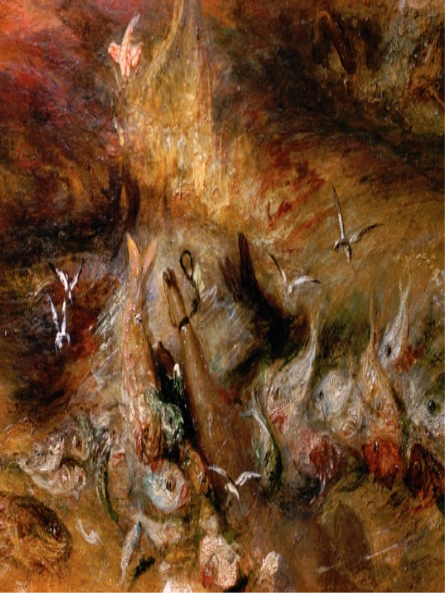
The image below is a depiction of the British Zong Massacre of 1782. The Zong set sail to Jamaica with 470 enslaved Africans. The greed of the captain and other crew members led them to take an additional 29 people, even though the ship could not accommodate so many human beings. They sailed through an area referred to as “the Doldrums” for its long periods of no wind. Stranded and sick, the captain decided to “jettison some of the cargo” to save the ship, and “provide the ship owners the opportunity to claim a loss on their insurance.” They threw 132 people overboard, and another 10 gave themselves to the see in what the captain described as in the courts as an “Act of Defiance”. The owner of the ship ended up filing the claim, and the courts sided with him in 1782. However, this massacre got public attention in Britain and helped gain momentum with the abolition movement there.

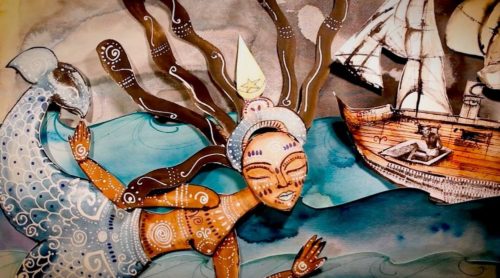
This story shines a little more light on different ways that the ocean’s water hold memories. Below is a depiction of the Yoruba orisha Yemaya, who lives in and has dominion over oceans, seas, and lakes. It is said that she traveled across the ocean with those who worshipped her on the slave ships, and because of her protection during that journey, she became one of the most beloved Orishas in the ‘New World’.
Our African ancestors need us to call out to them, affirm and love them, even if its painful. We must love our ancestors, those who endured and survived the middle passage, those who did not make it, and those who gave themselves to the ocean. A part of black feminist healing is being radically honest about the past, to that we can heal, and transform our communities to be even more resilient, even more free.
Segregation and Wade-ins
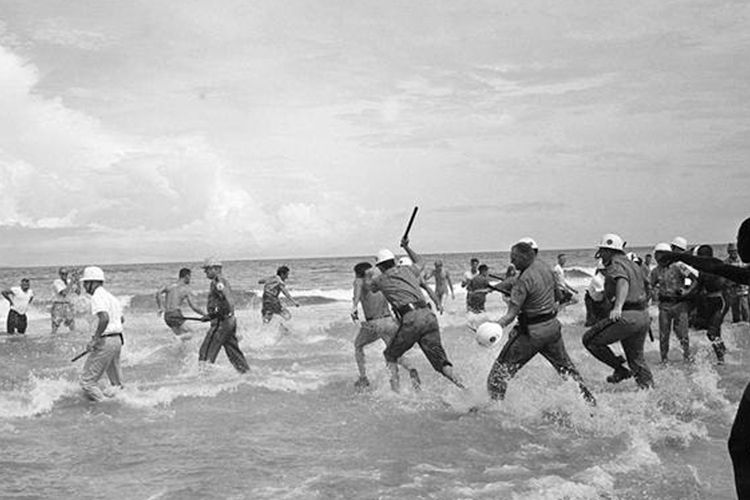
Fast forward form the era of chattel slavery to the era of Jim Crow- which was just the ethics of slavery re-invented, and we come to the Civil Rights Era. A time marked by sit-ins at lunch counters throughout the south, and many other peaceful protests that were met with extreme state violence. However, what has been considerably looked over and forgotten is the history of beach wade-ins and bodies of water, yet again, being sites of white violence against black bodies. Wade-ins reflect the history of water being both a metaphorical and literal site of trauma and memory from the middle passage.
On April 24, 1960 in Mississippi, the first battleground for integration happened on the beaches of Biloxi when 125 black women, children, and men walked on the sand with the hope of demonstrating a peaceful wade into the Gulf of Mexico. White civilian and police officers attacked them all with pool sticks, clubs, chains, lead pipes, and wire cable. The violence experienced by our enslaved African ancestors when they were first stolen from the shores of Africa and brought to the shores of Turtle Island (North America), and the violence endured there on the beaches throughout the southeast, are connected. The historical trauma from both events engendered economic and accessibility disparities between white Americans and black folk needs to be addressed with honesty and integrity.
Why don’t we learn about this event when we learn about Jim Crow and the Civil Rights Movement?
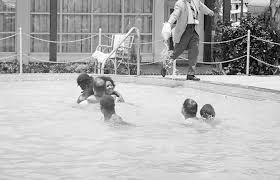
This image is from St. Augustine, Florida, 1964, when the hotel manager poured acid into the pool where people protesting segregation.
The movie Pride (2007) starring Terrence Howard is a story about a former competitive swimmer who out of his love for both swimming and black youth, decides to fix up an abandoned swimming pool and create Philadelphia’s first ever all black swim team in the 1970s. The creation of the swim team was a protest in response to city officials wanting to demolish the building for a “more profitable” development. A kind of unexpected twist to a very male- centered movie, is that a young black woman is the best swimmer on the team, and actually helps teach the boys how to be better swimmers. She then carries the team into the State Championships wearing her natural hair unapologetically.
Interviews conducted in an academic journal article, “Barriers to Swimming and Water Safety Education for African Americans” by Gail. H Ito, expose how black people are often seen as “cultural liabilities” in the eyes of institutions that make decisions that further perpetuate the exclusion of black communities in water safety education.“Mechanisms of social exclusivity (Hastings 989)” AKA classism, compounded with racism and sexism, limit access to bodies of water, and should therefore be considered a public health issue due to the fact that poor black and brown people have the highest rates of drowning in the world. Further, pools are “cultural fields that maintain socially segregated boundaries offering [club] members a significant, yet hidden vehicle through which they can facilitate their class and race privilege (DeLuca 340).” Therefore, black people swimming can be seen as an act of healing resistance to white supremacy.
Joy, Community, & Resistance
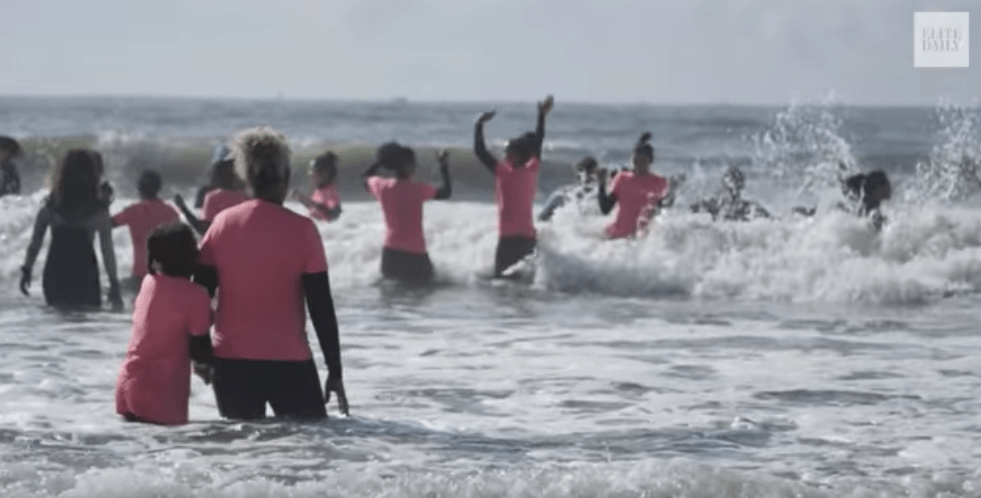
I highly encourage you all to watch this short video about the founders/ teachers of Brown Girls Surf, a group that offers surfing lessons to young black and brown girls here in the U.S. Their work is awesome and so wholesome! They combat the stereotypes about back women and girls and our hair, while showing the world the knowledge black women inherently possess on how our physical presence changes space. Brown Girls Surf discuss how important it is to make space for black girls to deepen their relationship to the ocean and with each other. It is an example of loving blackness as political resistance and celebrating the bodies and abilities of black women and girls.
“My presence in the water is so important. Its showing other women of color that this is not a “white man’s playground”. This is our playground. This is everybody’s playground.” – Natasha Brown, Teacher & Surfer, Brown Girls Surf
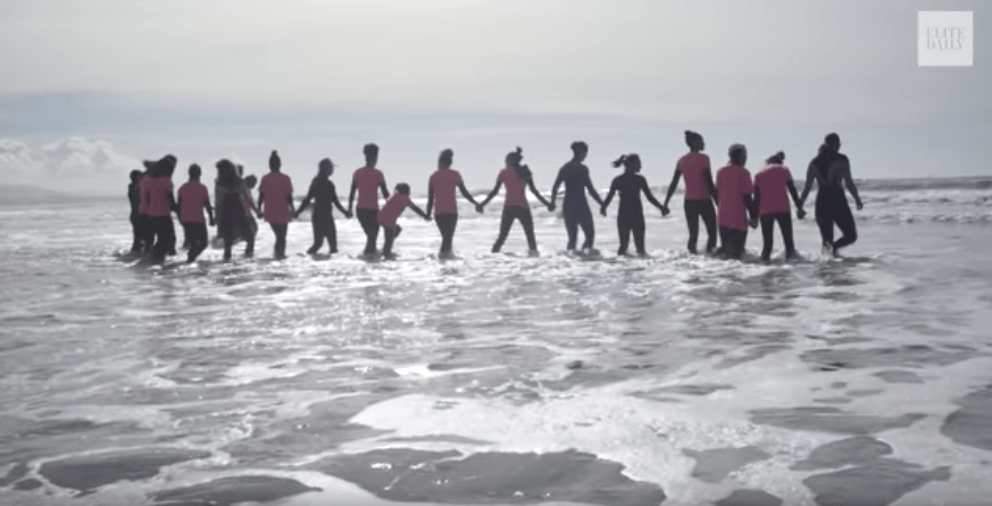
The generation people of born from around 1997-2000s, are seven generations into the future from the start of the abolition of chattel slavery in America. And while America never truly abolished slavery, through legalizing free and forced labor through the prison industrial complex with the 13th Amendment, our people have come a long way in our healing process from that horror of an atrocity called the middle passage.
The healing process is long, tiresome, but it also joyful. Our healing and reconnecting with the water is so important. Our joy in the water is important because we are communicating with our ancestors in the water, we are healing generations of wounds we didn’t even realize were there because we have grown so used to how they feel. The work of Brown Girls Surf is revolutionary in the sense that its giving young black girls the space to, as bell hooks writes in “Loving Blackness as Political Resistance”, “…to relearn the past, understand her culture and history, affirm her ancestors, and assume responsibility for helping other black folks to decolonize their minds (161).” Throughout so many cultures throughout the world, water as been a site of and a symbol of rebirth, reawakening, and cleansing. Through reconnecting with the water in positive and productive ways, we can heal ourselves and recover ourselves in love with the water, so that seven generations into the future black children will not be drowning at such alarming rates. Swimming while black is reconnecting and healing the generations of trauma. Swimming while black is resisting against white supremacist capitalism that wants to control our bodies and abilities, and control the spaces we enter into. Swimming while black tells other black people that we have total agency over our bodies and actions, and that resistance does not have to be rooted in sameness.
In the words of bell hooks, “Loving blackness as political resistance transforms our ways of looking and being, and thus creates the conditions necessary for us to move against the forces of domination and death and reclaim black life.”
Works Cited & Referenced
.Belek , Judy. “Op-Ed: An Unspoken Barrier to Getting More Black Girls in the Pool: the Hair Factor.” Los Angeles Times, Los Angeles Times, 23 Aug. 2016, www.latimes.com/opinion/op-ed/la-oe-belk-black-hair-swimming-20160824-snap-story.html.
Butler, J. Michael. “The Mississippi State Sovereignty Commission and Beach Integration, 1959-1963: A Cotton-Patch Gestapo?” The Journal of Southern History, vol. 68, no. 1, 2002, pp. 107–148. JSTOR, www.jstor.org/stable/3069692.
Coast-TV , WRDE, director. Amane Solomon Is First Black Female Lifeguard in Rehoboth Beach’s History.Youtube, 15 Aug. 2016, www.youtube.com/watch?v=KqIs2hdS_gE.
DeLuca, Jaime R. “Submersed in Social Segregation: The (Re)Production of Social Capital Through Swim Club Membership.” Journal of Sport and Social Issues, vol. 37, no. 4, Nov. 2013, pp. 340–363, doi:10.1177/0193723513498605.
Gershon , Livia. “When Cities Closed Pools to Avoid Integration .” JSTOR DAILY: Politics and History , 21 June 2019, daily.jstor.org/when-cities-closed-pools-to-avoid-integration/.
Gonera , Sunu, director. Pride . Pride , Lionsgate Films , 2007, www.youtube.com/watch?v=UcmgVt1Ta1U.
Hastings, Donald W., et al. “Drowning in Inequalities: Swimming and Social Justice.” Journal of Black Studies, vol. 36, no. 6, July 2006, pp. 894–917, doi:10.1177/0021934705283903.
Ito, Gail H. “Barriers to Swimming and Water Safety Education for African Americans.” International Journal of Aquatic Research and Education, vol. 8, no. 3, 1 Aug. 2014, doi:10.25035/ijare.08.03.04.
Kevin Dawson. “Enslaved Swimmers and Divers in the Atlantic World.” The Journal of American History, vol. 92, no. 4, 2006, pp. 1327–1355. JSTOR, www.jstor.org/stable/4485894.
Musto, Michela. “Athletes in The Pool, Girls And Boys On Deck: The Contextual Construction of Gender in Coed Youth Swimming.” Gender and Society, vol. 28, no. 3, 2014, pp. 359–380., www.jstor.org/stable/43669889.
Rhone , Trevor D, director. Smile Orange . Smile Orange , Knots Production , 1976. www.youtube.com/watch?v=VuDYeKDdZTU.
Wardi, Anissa Janine. Water and African American Memory: an Ecocritical Perspective. University Press of Florida, 2011.
Wiltse , Jeff. Contested Waters A Social History of Swimming Pools in America. Univ of North Carolina Pr, 2010.
https://www.essence.com/news/simone-manuels-why-olympic-win-so-important/
 Swimming While Black